
More UK residents are reassessing where they live, work and raise their families. Dubai has emerged as a serious alternative not as an escape, but as a considered lifestyle and strategic decision. For many UK individuals and families, Dubai represents improved lifestyle flexibility, global business access and long-term planning advantages. The key is not whether Dubai is attractive but whether it is right for you, your family and your goals.
Dubai is no longer viewed simply as a tax efficient location. It is a fully established international hub with strong regulation, modern infrastructure and a clear long-term vision.
UK residents are increasingly attracted to Dubai for several practical reasons:
While financial efficiency is often the starting point, lifestyle and quality of life are usually what make people commit to the move.
Dubai offers modern housing, year round sunshine and a strong sense of personal safety. Families benefit from internationally recognised education options, excellent healthcare facilities and a family-friendly environment. Professionals and business owners value the city’s ambition, convenience and focus on growth.
With a large and well established UK expat community, many people find the transition smoother than expected both socially and professionally.
Relocating to Dubai is entirely achievable but it does require careful planning and the right sequence of steps.
Residency visas, business setup, banking, housing and family arrangements are all interlinked. Decisions made early in the process can have long-term implications, both in the UAE and in the UK.
Without a structured approach, individuals risk delays, unnecessary costs or compliance issues. With the right planning, the move becomes straightforward, efficient and aligned with long-term goals.
Many people delay their move not because Dubai isn’t right for them but because the process feels overwhelming or unclear.
Having the right support removes complexity. A coordinated approach brings everything together, ensures each step is handled correctly and allows you to focus on the opportunity ahead, rather than the administration behind it.
Whether you’re relocating on your own, with family or through a business, the right guidance turns a major life decision into a manageable and well planned transition.
Even empty, it keeps you UK tax resident. Risk: full worldwide income exposure.
The UK has no general exit tax in 2026. But two mechanisms catch people out:
The real barrier isn’t an exit tax. It’s the 5-year clawback. Staying out for five full tax years is the only clean solution.
Relocating to Dubai is a significant decision and it deserves clear, practical advice based on your circumstances.
At Dubai Oneway, we support UK clients through every stage of the relocation process, helping them understand their options, plan effectively and move forward with confidence.
We combine UK expertise with on the ground UAE partnerships to deliver a complete, end-to-end relocation experience covering everything from visas and housing to business setup, schooling, and lifestyle support.

Business &
Company Formation

Visa, Residency &
Emirates ID

Property Search
& Leasing

Home Removals & International Shipping

Schooling &
Family Support

Car Leasing
& Logistics

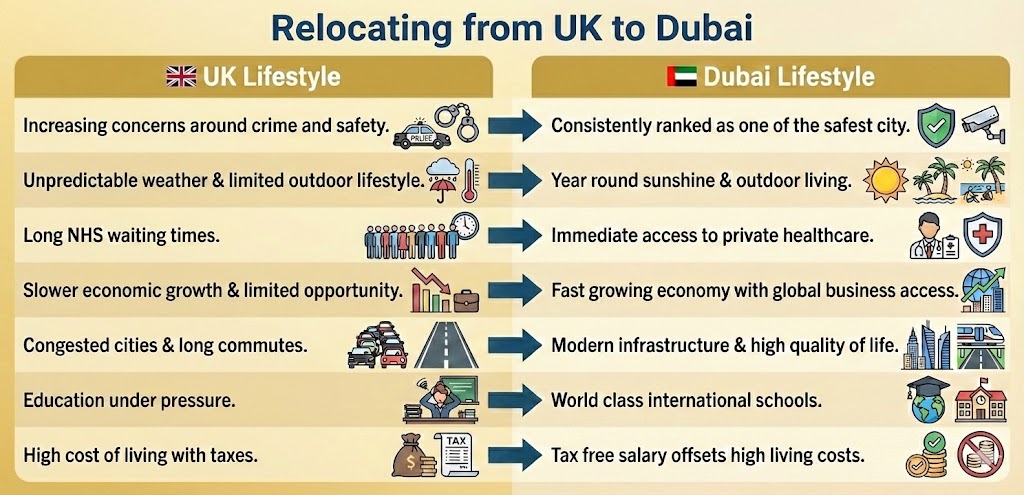
| 🇬🇧 UK Lifestyle | 🇦🇪 Dubai Lifestyle |
|---|---|
| Increasing concerns around crime and safety | Consistently ranked as one of the safest cities globally |
| Unpredictable weather and limited outdoor lifestyle | Year round sunshine and outdoor living |
| Long NHS waiting times | Immediate access to private healthcare |
| Slower economic growth and limited opportunity | Fast growing economy with global business access |
| Congested cities and long commutes | Modern infrastructure and high quality of life |
| Education under pressure | World class international schools |
| High cost of living with taxes | Tax free salary offsets high living costs |
Relocating from the UK to Dubai has become an increasingly popular and well considered move for professionals, families and business owners looking for greater flexibility, opportunity and long-term stability.
What often begins as a future idea is now becoming a realistic next step for many. Dubai has positioned itself as a global city that supports modern living, international business and long-term planning making it one of the fastest-growing destinations for UK residents.
Dubai is no longer viewed simply as a tax efficient location. It is a fully established international hub with strong regulation, modern infrastructure and a clear long-term vision.
UK residents are increasingly attracted to Dubai for several practical reasons:
For many, Dubai offers clarity and consistency at a time when long-term planning in the UK can feel increasingly complex.
Dubai is no longer viewed simply as a tax efficient location. It is a fully established international hub with strong regulation, modern infrastructure and a clear long-term vision.
UK residents are increasingly attracted to Dubai for several practical reasons:
For many, Dubai offers clarity and consistency at a time when long-term planning in the UK can feel increasingly complex.
While financial efficiency is often the starting point, lifestyle and quality of life are usually what make people commit to the move.
Dubai offers modern housing, year round sunshine and a strong sense of personal safety. Families benefit from internationally recognised education options, excellent healthcare facilities and a family-friendly environment. Professionals and business owners value the city’s ambition, convenience and focus on growth.
With a large and well established UK expat community, many people find the transition smoother than expected both socially and professionally.
Relocating to Dubai is entirely achievable but it does require careful planning and the right sequence of steps.
Residency visas, business setup, banking, housing and family arrangements are all interlinked. Decisions made early in the process can have long-term implications, both in the UAE and in the UK.
Without a structured approach, individuals risk delays, unnecessary costs or compliance issues. With the right planning, the move becomes straightforward, efficient and aligned with long-term goals.
Relocating to Dubai is entirely achievable but it does require careful planning and the right sequence of steps.
Residency visas, business setup, banking, housing and family arrangements are all interlinked. Decisions made early in the process can have long-term implications, both in the UAE and in the UK.
Without a structured approach, individuals risk delays, unnecessary costs or compliance issues. With the right planning, the move becomes straightforward, efficient and aligned with long-term goals.
Many people delay their move not because Dubai isn’t right for them but because the process feels overwhelming or unclear.
Having the right support removes complexity. A coordinated approach brings everything together, ensures each step is handled correctly and allows you to focus on the opportunity ahead, rather than the administration behind it.
Whether you’re relocating on your own, with family or through a business, the right guidance turns a major life decision into a manageable and well planned transition.
Relocating to Dubai is a significant decision and it deserves clear, practical advice based on your circumstances.
At Dubai Oneway, we support UK clients through every stage of the relocation process, helping them understand their options, plan effectively and move forward with confidence.
Relocating to Dubai is a significant decision and it deserves clear, practical advice based on your circumstances.
At Dubai Oneway, we support UK clients through every stage of the relocation process, helping them understand their options, plan effectively and move forward with confidence.
Relocating to Dubai can deliver complete UK tax freedom but only if the move is structured correctly. These are the eight most costly mistakes, ranked by financial risk and frequency among UK professionals.
1. Keeping a UK Home Available for Personal Use
Risk: £100,000+ annual worldwide tax exposure
HMRC's Statutory Residence Test treats any UK property available for your personal use even if empty or used informally by family as a major tie to the UK. This alone can keep you a UK tax resident, meaning all worldwide income remains taxable in the UK.
Fix: Let on a commercial tenancy to an unrelated third party before you leave.
2. Leaving Without Split-Year Treatment
Risk: Full departure year's worldwide income taxed in the UK
Rushing your move without the correct sequence UAE visa, physical relocation, then HMRC notification means you are unlikely to qualify for split year treatment. HMRC will tax your entire departure year's income even if you only spent three months in the UK.
Fix: Plan a 3–6 month structured transition with a tax advisor.
3. Spending Too Little Time in Dubai
Risk: Failed non-residency claim and years of audits
A UAE Tax Residency Certificate requires 183+ days of physical presence or demonstrably strong UAE ties. Sporadic visits combined with UK family connections or property give HMRC grounds to maintain you are still a UK resident leading to 3–5 years of disputed status and investigation.
Fix: Track your days rigorously and establish a clear UAE centre of life.
4. Confusing a Golden Visa with Tax Residency
Risk: Open ended UK tax exposure
A UAE Golden Visa confirms immigration status only. HMRC requires an official Tax Residency Certificate issued by the UAE Ministry of Finance before it will accept a non residency claim. Without it, treaty benefits fail and UK tax exposure remains indefinite.
Fix: Apply for your Tax Residency Certificate after 183 days, supported by accommodation proof.
5. Not Sorting Pensions and ISAs Before Leaving
Risk: 25–45% unnecessary UK tax withholding
Providers may withhold UK tax on withdrawals unless your non-UK tax residence and treaty position are confirmed in advance. Reclaiming overpaid tax typically takes 12 months or more.
Fix: Notify providers before your first withdrawal and take advice on QROPS or pension transfers.
6. Poor Timing on UK Property Sales
Risk: £50,000–£500,000 in CGT bills
Selling your former UK home as a non resident significantly reduces Principal Private Residence Relief. Non-residents pay CGT on UK property gains, producing substantial bills on typical family properties.
Fix: Time the sale before departure or take advice on specialist trust structures.
7. Setting Up a Business Without Economic Substance
Risk: Rejected residency claim and UAE tax penalties
Both HMRC and UAE authorities reject companies created purely for visa purposes without genuine UAE activity, real clients, contracts, and bookkeeping. Without substance, the arrangement fails on both sides.
Fix: Operate a genuine business supported by UAE bank statements and audited accounts.
8. Leaving Significant Cash in UK Bank Accounts
Risk: Ongoing UK tax and residency complications
Large UK account balances generate UK source interest income and weaken your non residency claim. Mixed fund tracking quickly becomes a compliance burden.
Fix: Transfer surplus liquid assets to UAE banks within six months of relocating.
Dubai Oneway's tax and structuring partners address every one of these points before your move, not after. Getting the sequence right from day one is the difference between a clean break and years of HMRC correspondence.
The UK-UAE Double Taxation Agreement (DTA), in effect since 2016, ensures that expats are not taxed twice on the same income. It allocates taxing rights between the two countries and includes several provisions that work directly in favour of UAE residents.
Residency Tie-Breaker
Where there is a dispute over tax residency, the DTA resolves it through a hierarchy: permanent home first, then centre of vital interests, then habitual abode, and finally nationality. Establishing a clear UAE base at every level is the strongest position.
Key Provisions at a Glance
Pensions (Article 17) — Taxed in the country of residence. For UAE residents, this means 0%.
Employment Income — UAE residents working fewer than 183 days per year in the UK are taxed only in the UAE.
Business Profits — Taxed where a Permanent Establishment exists, making entity structure an important consideration.
Dividends and Interest — Subject to reduced withholding taxes of between 0% and 15%, depending on the source.
Why It Matters
The DTA is one of the most valuable tools available to UK expats relocating to Dubai. Used correctly alongside proper residency planning, it can eliminate UK tax on pensions, employment income, and investment returns entirely. Dubai Oneway's tax partners will ensure your structure makes full use of it.
The UK has no general exit tax on personal assets for expats leaving in 2026. However, two mechanisms function as exit traps that every leaver should understand.
The Temporary Non-Residence Rule (5-Year Trap)
If you leave the UK, become non-resident, and return within 5 tax years, HMRC will retrospectively tax foreign income and gains realised abroad during your absence including dividends. From April 2026, this tightens further all dividends taken abroad become taxable upon your return, removing the previous exemption for post departure profits. In practical terms leave in April 2026 and return before April 2031, and you face full UK tax exposure on your Dubai income.
The Proposed Settling-Up Charge (Not Yet Law)
As of late 2025, the Treasury was considering a 20% charge on unrealised gains in business assets and shares at the point of departure. This remains speculation only and has not been enacted but it is worth monitoring.
The Bottom Line
There is no exit tax today, but the 5-year clawback is the real barrier. Staying out for five full tax years is the clean solution.
Dubai Oneway coordinates with specialist tax partners to navigate this combining a UAE Tax Residency Certificate with structured 5-year planning. Your Wealth Management service will address this upfront with qualified tax advisors.
Retaining a UK property “just in case” can weaken your non-residency position. If you keep property in the UK, it should be clearly let to third parties on commercial terms, rather than kept available for personal use.
One of the most common mistakes is relocating to Dubai without properly addressing UK residency. HMRC looks at the full picture — if too many UK ties remain, they may still treat you as UK tax resident.
While UAE tax residency can be achieved with a minimum presence, spending only the bare minimum particularly if you spend more time elsewhere can create uncertainty. In practice, your centre of life should clearly be in Dubai.
A company created purely to obtain a visa, with little or no genuine activity, can create risk. Businesses should have real operations, contracts, transactions and proper book keeping to demonstrate substance.
The UK–UAE tax treaty prevents double taxation, but certain UK income such as rental income from UK property may remain taxable in the UK. These nuances often catch people out if not planned for properly.
Some people leave the UK without formally notifying HMRC of their change in residency. This often leads to issues later, as HMRC will expect clear evidence of when and how residency changed.
The treaty helps determine which country has primary taxing rights based on where you are considered resident. If you are genuinely UAE resident and properly non-resident in the UK, your worldwide income is generally outside the scope of UK tax.
Some UK income particularly from UK property may still be taxed in the UK even after you become a UAE resident. The treaty ensures you are not taxed twice, but it does not eliminate UK tax on all UK-based income.
Gains from selling UK property may still fall within UK tax rules depending on timing and circumstances. Planning before disposing of major assets is essential.
UK pension income received while a UAE resident is typically taxable only in the UAE under the treaty. As the UAE does not levy personal income tax, this can be particularly attractive for retirees but professional advice is strongly recommended.
Treaty protection must be demonstrated. This usually involves obtaining UAE tax residency certificates and keeping clear evidence of your residency status and time spent in the country.
WhatsApp us